

|


Fujitsu SAS Drives and Highpoint RocketRAID 2640X4 Testing in Linux

Drivers
HighPoint offers an open source driver for the RocketRAID 2640X4 the Linux kernel versions 2.4 and 2.6, for both 32bit and 64bit Intel platforms. This is a nice feature for the purist that wants to keep their systems free from proprietary drivers and modules. Major distributions like Fedora, RHEL, CentOS, OpenSuSE, SuSE, SuSE Enterprise, FreeBSD and Macintosh have binary packages provided for their respective package managers. Notably, HighPoint doesn't offer a pre-compiled version of their driver for Debian based distros. The lack of a binary driver package for Debian implies that Ubuntu Server is not directly supported, however the open source driver is easily compiled on any Linux platform with a modern version of the GCC compiler suite and the kernel headers installed. I did a test compile of the open source driver on Ubuntu server, and successfully got the driver compiled and loaded with no issues. The readme provided in the driver download is quite good and steps you through the way. While to the experienced Linux user, the compilation of a driver from source should not be a major issue, the newbie is warned in this case to RTFM. The open source driver also has the ability to be applied as a patch to the Linux kernel source, this means that if you are running a custom kernel that for some reason is binary incompatible with the provided driver, you can apply the patch and rebuild to obtain hardware support.
Here are the driver links as presented on the manufacturer website:
- Fedora - Download
- RHEL - Download
- CentOS - Download
- SuSE - Download
- SuSE Enterprise - Download
- FreeBSD - Download
- Macintosh - External Site
- Source - Download

Configurations
The test system that I used during my performance testing consisted of the following parts:
| Motherboard | Tyan Tomcat n3400B |
| Processor | AMD Opteron 1218 HE |
| Memory | Corsair ValueSelect (2 x 1GB) DDR2 SDRAM DDR2 667 (PC2 5300) |
| Chipset | nVIDIA nForce Pro 3400 |
| Hard Disk Drive | Fujitsu SAS Drives 15k.5 (4x RAID 5) |
The Operating system that I chose to use was the Community Enterprise Operating System or CentOS. While CentOS does not ship with a driver for the RocketRAID 2640X4, I found it quite easy to download the tgz file and install the driver module from the manufacturer website. Once I finished the driver installation process, which was taken directly from the readme file included in the driver tarball, I created an ext2 filesystem with no additional options over the defaults. I performed a variety of tests, and tabulated the results. I then created an ext3 filesystem with the default journal options and performed tests. The results are listed and explained in detail below.
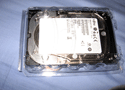
We would like to thank Fujitsu for donating the hard drives used in this testing. The MAX3147 SAS are perfect for use in critical role servers and workstations where performance and reliability are key. For gaming these drives are relatively inexpensive and when combined in a raid configuration such as we have here the performance is blazing fast.

Fujitsu Specifications:
| Model | MAX3036RC | MAX3073RC | MAX3147RC | |
|---|---|---|---|---|
| Functional Specifications | ||||
| Storage Capacity (formatted)(1) | 36.7GB | 73.5GB | 147.0GB | |
| Disks | 1 | 2 | 4 | |
| Heads (read/write) | 2 | 4 | 8 | |
| Bytes/Sector | 512 | |||
| Seek Time | Track to track | Read: 0.2 ms (typ) / Write: 0.4 ms (typ) | ||
| Average | Read: 3.3 ms (typ) / Write: 3.8 ms (typ) | |||
| Full track | Read: 8.0 ms (typ) / Write: 9.0 ms (typ) | |||
| Average Latency | 2.0 ms | |||
| Rotational Speed | 15,000 RPM | |||
| Areal Density | 59 Gbits/sq. in. | |||
| Data Transfer Rate | To/from media | 147 MB/s | ||
| To/from host | SAS: 3Gbps | |||
| Recording Code | 32/34 MEEPRML | |||
| Interface | Dual Port SAS | |||
| Head Positioning Method | Rotary VCM | |||
| Start Time | 30 s (typ) | |||
| Stop Time | 30 s (typ) | |||
| Buffer Size(2) | 16 MB | |||
| Physical Specifications | ||||
| Power Requirements | Voltage | 5 V ± 5%, 12 V ± 5% | ||
| Spin-up | 12V ± 5%, 2.5 A (peak) 5V ± 5%, 0.7 A (peak) |
|||
| Idle (typ.) | 11.5W | |||
| Dimensions (HxWxD) | 25.4mm x 101.6mm x 146.0mm | |||
| Weight | 750g | |||
| Ambient Temperature | Operating | 5°C to 55°C (DE base 60°C max) | ||
| Non-operating | -40°C to 70°C | |||
| Gradient | 15°C/H max | |||
| Relative Humidity | Operating | 5% to 95% (non-condensing) | ||
| Non-operating | 5% to 95% (non-condensing) | |||
| Max. wet bulb | 29°C (operating) | |||
| Vibration | Operating | 0.6 mm (5 to 20 Hz) / 1.0 G (20 to 300 Hz) | ||
| Non-operating | 3.1 mm (5 to 20 Hz) / 5.0 G (20 to 300 Hz) | |||
| Shock | Operating | 65 G max. (2 ms) | ||
| Non-operating | 250 G max. (2 ms) | |||
| Altitude (operation) | Operating | 3,048 m (max.) | ||
| Non-operating | 12,192 m (max.) | |||
| Acoustics Noise (idle sound power) (typ.) | </= 3.6bels (ready) | |||
| Reliability Specifications | ||||
| MTBF | 1,200,000 hours | |||
| Component Life | 5 years | |||
| Error Rates | Seek error | 10 per 108 seeks | ||
| Unrecoverable errors | 1 per 1015 bits read | |||
| Limited Warranty | 5 years (from date of purchase). Visit online or call toll free at (800) 626-4686 for full Limited Warranty details and restrictions. | |||
Features:
State-of-the-art hard disk drives for your most demanding enterprise applications
- 3.5-inch RoHS compliant enterprise hard disk drives offer 15K RPM spindle speed and feature storage capacities up to 147GB
- Ideal for applications requiring high performance and high bandwidth
- Native Command Queuing (NCQ), providing faster execution of operation commands
- Uses smaller connectors and cables than U320, a benefit acknowledged by the SCSI Trade Association (STA)
- Point-to-point connections allows for improved input-output per second (IOPS) in proportion to the number of drives connected.
REALTIME PRICING