
Introduction
Majority of electronics fall into one of two categories: consumer or enterprise. Typically the price tags very significantly between the two, but you usually get what you pay for. Enterprise equipment is generally put through more quality assurance testing than the consumer edition of the same product. Large corporations are happy to front the bill for enterprise equipment if it means they can have that much less downtime. When it comes to SOHO, the bill can be a bit more difficult to front. SOHO still need as much up time as possible, but don’t always have the budget. Western Digital tries to address this market with their new line of Red Drives. Sticking to their color theme, this drive series is aimed at NAS devices. They sport many of the features of the enterprise RE line that Western Digital already has, but at a much lower price point. Today we take a look at the 2TB version of the Red Drive and see how it stacks up in our lab.

Specifications
| Product Specifications | Environmental Specifications | ||
| Interface | SATA 6 Gb/s | Shock | |
| Performance Specifications | Operating Shock (Read) | 65G, 2 ms | |
| Rotational Speed | IntelliPower | Non-operating Shock | 250G, 2 ms |
| Buffer Size | 64MB | Acoustics | |
| Transfer Rates | Idle Mode | 23 dBA (average) | |
| Buffer To Host (Serial ATA) | 6 Gb/s (Max) | Seek Mode 0 | 24 dBA (average) |
| Physical Specifications | Temperature (English) | ||
| Formatted Capacity | 2,000,398 MB | Operating | 32° F to 158° F |
| Capacity | 2 TB | Non-operating | -40° F to 158° F |
| User Sectors Per Drive | 3,907,029,168 | Temperature (Metric) | |
| Performance Specifications | Operating | -0° C to 70° C | |
| Target Performance | Non-operating | -40° C to 70° C | |
| MTBF | 1,000,000 hours | Humidity | |
| Physical Dimensions | Operating | 5-95% RH non-condensing | |
| English | Vibration | ||
| Height | 1.028 Inches | Operating | 0.004 g²/Hz (10 to 300 Hz) |
| Depth | 5.787 Inches | Non-operating | 0.05 g²/Hz (10 to 300 Hz) |
| Width | 4.00 Inches | Operating | |
| Weight | 1.40 Pounds | Linear | 20-300 Hz, 0.75G (0 to peak) |
| Metric | Electrical Specifications | ||
| Height | 26.1 mm | Current Requirements | |
| Depth | 147 mm | 12 VDC | |
| Width | 101.6 mm | Read/Write | 250 mA |
| Weight | 0.635 kg | Idle | 230 mA |
| Standby | 7 mA | ||
| Sleep | 7 mA | ||
| 5 VDC | |||
| Read/Write | 280 mA | ||
| Idle | 260 mA | ||
| Standby | 105 mA | ||
| Sleep | 105 mA | ||
| Power Dissipation | |||
| Read/Write | 4.40 Watts | ||
| Idle | 4.10 Watts | ||
| Standby | 0.60 Watts | ||
| Sleep | 0.60 Watts |
–~~~~~~~~~~~~–
A Closer Look
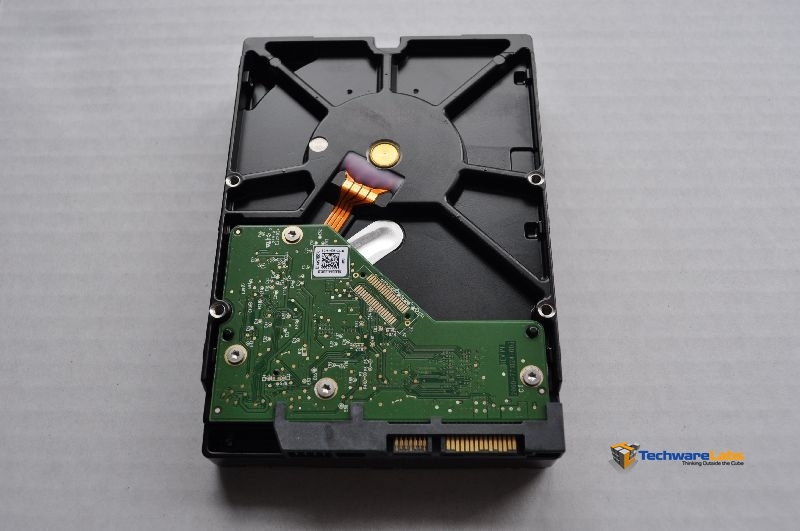
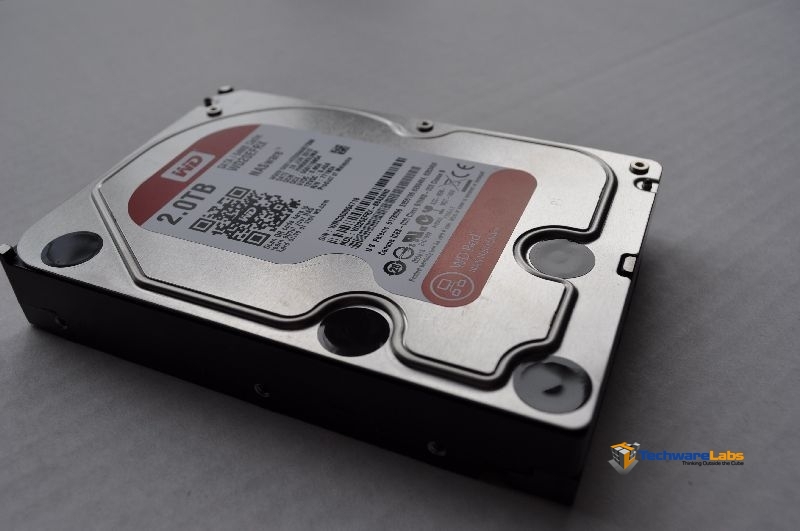
On the outside the Red Drives look like any other of Western Digital’s drives. Under the hood, however, the Red Drives differ greatly from the other lines. Western Digital is touting new firmware for these line of drives, and it’s called NASware.
|
 |
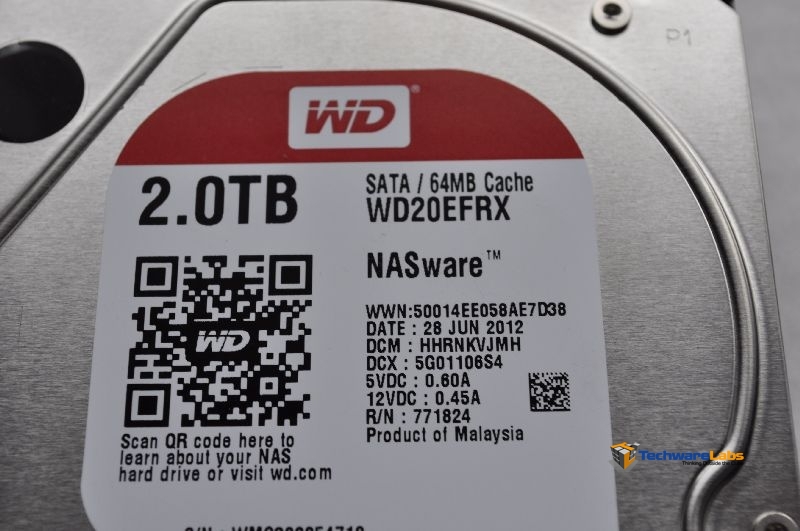
NASware provides tuning similar to that of the Green Drives, by dynamically adjusting how fast the platters spin (WD calls the feature Intellipower). On the other hand, the feature set is closer to that of their enterprise RE line of drives. The Red Drive supports things like TELR (Time Limited Error Recovery) which helps prevent a drive from being dropped from a RAID array. It is also supposed to be better balanced to help reduce vibration issues that may occur in large RAID arrays. The interface for the Red Drive is 6.0 Gb/s SATA 3 connection, as is common for all new hard drives.
 |
 |
WD is also claiming that this drive has increased compatibility with NAS devices. They’ve even gone so far as to make a web page dedicated to what NAS devices have been tested with the Red Drive. Another difference between the Red Drive and other WD drives is that the onboard cache is now DDR2, where as in the past it has been DDR. This should help speed things up.
–~~~~~~~~~~~~–
Test Rig
- TYAN S5510GM3NR Server Motherboard
- Intel Xeon E31220
- 16GB Kingston KVR1333D3E9S/4GEC
- Crucial 128GB SSD Solid State Hard Drive
- Windows Sever 2008 R2
For our testing we performed each of our benchmarks with both the drive in standalone mode and in RAID 5. While the Red Drives are aimed at the NAS market, a file server is still a perfectly legitimate use for them.
ATTO Disk Benchmark
 |
 |
||
| RAID 5 | Single Drive |
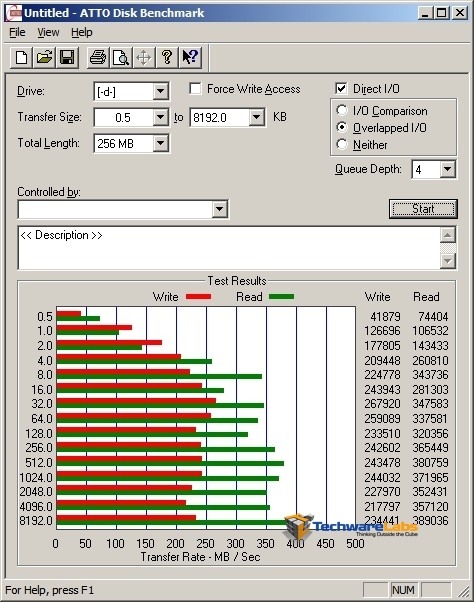
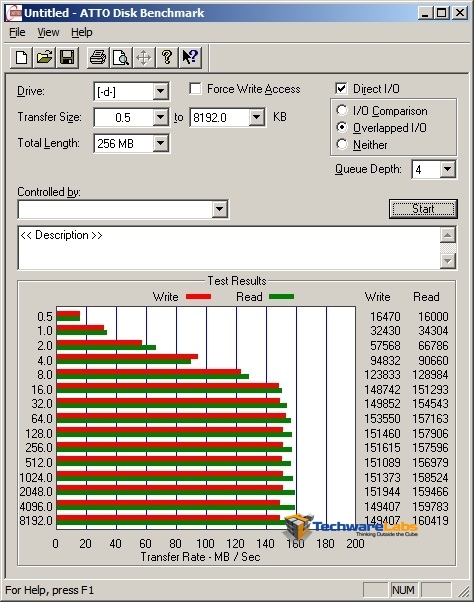
In the single drive test we can see that the drive gets around 151 MB/s write speed and 157 MB/s read. This is actually faster than the max specs for the drive. It’s nice to see WD doesn’t post best case specifications. When the 4 Red Drives are in RAID 5, we see that write speeds are faster than a single drive, but still far below the read speed. This is to be expected, and is an inherit issue with RAID 5. The read speeds on the other hand are significantly higher, averaging around 300 MB/s
CrystalDiskMark
 |
 |
||
| RAID 5 | Single Drive |
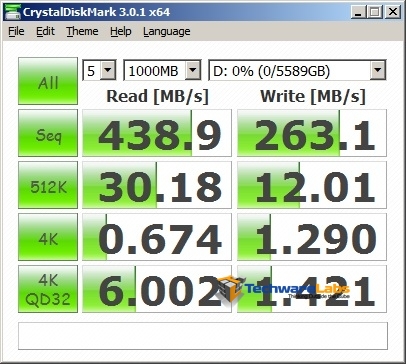
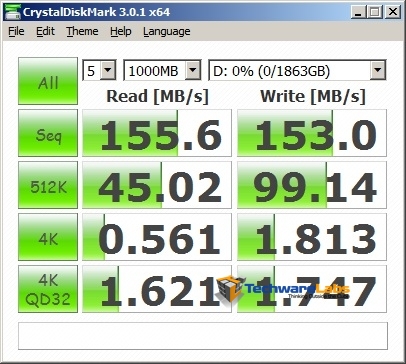
The RAID 5 read speeds are quite impressive at 429.9 MB/s. The write speeds are also quite respectable. Both read and write speeds are above 150 MB/s for the single drive, which is very good. With the IntelliPower variable RPM on the Red Drive, you wouldn’t expect it to perform at the same level as some 7200 RPM drives, but you would be wrong.
HDTune
 |
 |
||
| RAID 5 – Write | Single Drive – Write | ||
 |
 |
||
| RAID 5 – Read | Single Drive – Read |
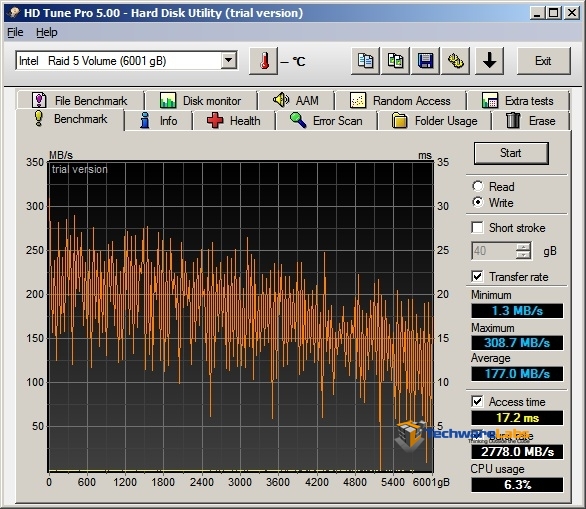
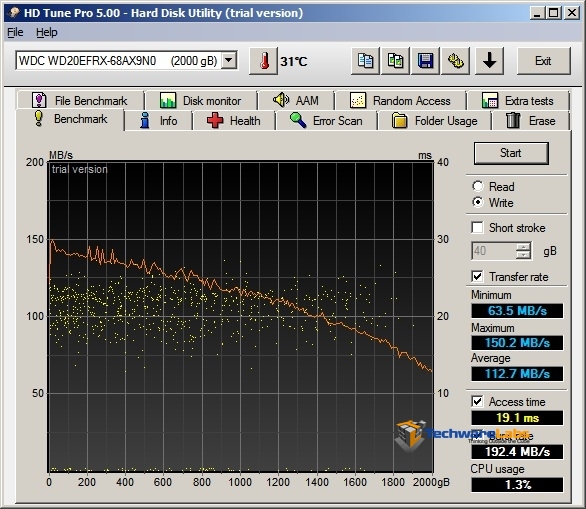
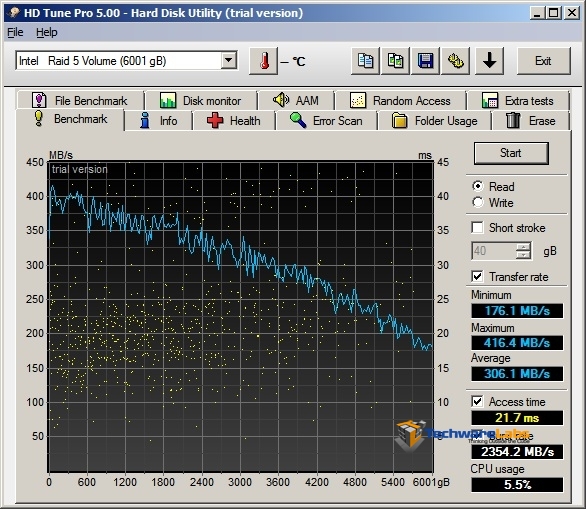
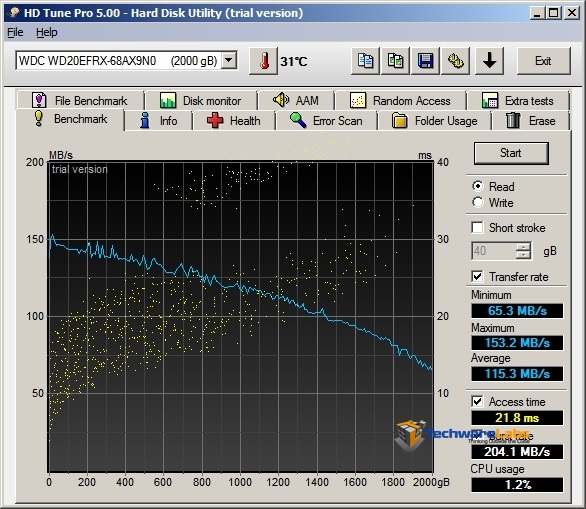
HDTune tests the entire length of a drive instead of just a small area. Because of how traditional platter hard drives work, their speed can vary depending on where on the platter you are. HDTun shows a nice graph of the speed of the drives. We can see that the results of this benchmark are right in line with what we’ve been seeing in the others.
Windows File Transfer
 |
 |
||
| Write | Read |
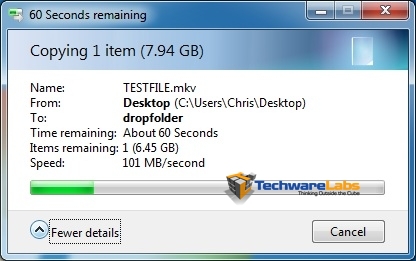
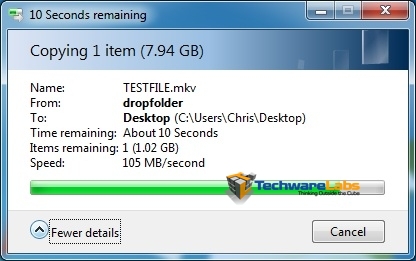
For our file transfer test we have the drives in a RAID 5 and configure a shared folder where we copy a large movie file to and from the share. We can see that the transfer rate is easily saturating the single gigabit connection to the file server. Unless you are using teamed NICs for your file server, you won’t be getting all the performance that these drives can deliver.
Conclusion
Western Digital has an interesting product here. It falls right in between their consumer line of drives and their enterprise line. This makes it perfect for small businesses that can’t afford a SAN, but can afford a NAS. The feature set rivals that of the RE enterprise drives, but with a thermal and power footprint similar to the Green Drives. At time of writing the 2TB Red Drive is selling for $130, which more expensive than the Green Drive, cheaper than the Black drives, and far cheaper than a RE drive. The performance of the drive is also exceptional. If your NAS doesn’t have teamed NICs, then it’s not fully utilizing these drives. I think that WD has a real hit on their hands here. My only gripe is that it comes with a 3 year warranty. Gone seem to be the halcyon days of the standard 5 year warranty for hard drives. The Red Drive fills a nice niche in the SOHO storage market.
Pros
- Designed for use in NAS and RAID arrays
- Solid performance
- Cooler thermal profile than other drives
Cons
- Only a 3 year warranty


[…] Western Digital Red Drive 2TB Hard Drive @ TechwareLabs […]
[…] Western Digital Red Drive 2TB Hard Drive @ TechwareLabs […]
[…] Western Digital Red Drive 2TB Hard Drive @ TechwareLabs […]
[…] Western Digital Red Drive 2TB Hard Drive @ TechwareLabs […]
[…] Western Digital Red Drive 2TB Hard Drive @ TechwareLabs […]