

Hitachi CML152 15" LCD Monitor
Review by Harry Lam on 08.29.03
Monitor provided by
Monitors Direct/Hitachi, Price: $315.00
Overview:
The Hitachi CML152 LCD has an
MSRP of $315, and offers an extremely high viewing angle (130 degrees).
Other features of the CML152 include, 350:1 contrast ratio, 35ms pixel response,
0.297mm dot pitch, and native resolution of 1024x768@75Hz are about average
when comparing to other LCD's.
History of TFT LCD:
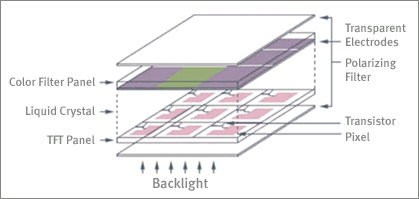
Liquid crystal was discovered by the Austrian botanist Fredreich Rheinizer in 1888. "Liquid crystal" is neither a solid nor liquid (an example is soapy water). In the mid-1960s, scientists showed that liquid crystals when stimulated by an external electrical charge could change the properties of light passing through the crystals. The early prototypes (late 1960s) were too unstable for mass production. But all of that changed when a British researcher proposed a stable, liquid crystal material (biphenyl). Today's color LCDs have a sandwich-like structure (see figure below).
What is TFT LCD Technology?:
TFT LCD (Thin Film Transistor Liquid Crystal Display) has a sandwich-like structure with liquid crystal filled between two glass plates.
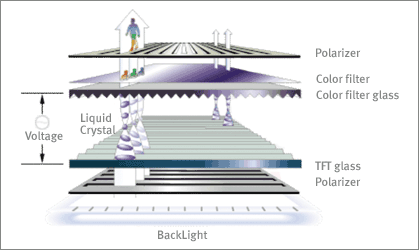
TFT Glass has as many TFTs as the number of pixels displayed, while a Color Filter Glass has color filter which generates color. Liquid crystals move according to the difference in voltage between the Color Filter Glass and the TFT Glass. The amount of light supplied by Back Light is determined by the amount of movement of the liquid crystals in such a way as to generate color.
TFT LCD Electronic Aspects:
The most common liquid-crystal displays
(LCDs) in use today rely on picture elements, or pixels, formed by liquid-crystal
(LC) cells that change the polarization direction of light passing through them
in response to an electrical voltage.
As the polarization direction changes, more or less of the light is able to
pass through a polarizing layer on the face of the display. Change the voltage,
and the amount of light is changed.
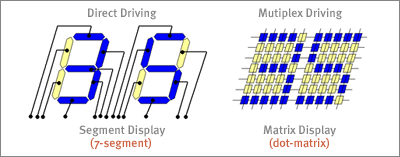
There are two ways to produce a liquid-crystal image with such cells:
1. The segment driving
method.
2. The matrix driving method.
The segment driving method displays characters and pictures with cells defined
by patterned electrodes.
The matrix driving method displays characters and pictures in sets of dots.
1. Direct vs. multiplex driving of LCDs.
| « Previous Page | Next Page » |