

|


AMD Phenom 9600 Black Edition
Phenom 9600 Black Edition
With the release of the Phenom Processor AMD has introduced the first native quad core consumer level processor. Unfortunately as has been shown in reviews around the net the Phenom is still not the performance king despite being one of the newest processors released to the market. Thus AMD follows true to tradition and has released an unlocked or "Black Edition" of their processor. AMD intends these Black Edition processors to invigorate interest in AMD products by catering toward the enthusiast desires to overclock. Initially the Black Edition was introduced in the AMD 64 X2 6400+ and later went mainstream with the 5000+ as a method of competition against the Extreme Edition processors from Intel. as you are probably aware the Black Edition processors are totally unlocked to allow full CPU multiplier manipulation which attracts serious overclockers and enthusiasts looking to get a bit more out of their machine.
Aside from the unlocked multiplier the Balck Edition processors are identical their same model number counterparts in all other ways. For the Phenom 9600 this means both the standard 9600 and the 9600 Blackk Edition start at 2.3 GHz and are based on the 65nm manufacturing process. With pricing identical for the two parts there really is no reason to purchase a Black Edition and try a bit of overclocking yourself. We received a sample of the Phenom 9600 Black Edition for testing here at TechwareLabs and have put it through a battery of tests. We will discuss the results later but first a few notes on what Phenom brings to the table.
The AMD Difference
We continue to believe that AMD is an innovator in the market and that the technologies you saw released with the Phenom and Spider platform discussed in our technology preview here, will be adopted as standard and have significant market and technology influence in the future. As other sites have truthfully noted most consumers are primarily concerned with:
- Price
- Performance
- Availability
While the Phenom is available and has a good price for the processor, the platforms cost more and the performance at this time is not as good as the core 2 quad processors from Intel. With the 17 Phenom recommended platforms below the price ranges from $150 to $250 which is a bit higher than most consumers are seeking to spend.
|
Chipset |
Motherboard |
Revision |
Form Factor |
Socket |
AMD 790FX |
Asus M3A32-MVP deluxe |
1 |
ATX |
AM2 |
|
AMD 790FX |
MSI K9A2 Platinum (MS-7376) |
1 |
ATX |
AM2 |
|
AMD 790X |
MSI K9A2 CF (MS-7388) |
1 |
ATX |
AM2 |
|
AMD 790FX |
Gigabyte GA-MA790FX-DQ6 |
1 |
ATX |
AM2 |
|
NVIDIA nForce® 590 SLI™ |
Asus Crosshair |
1.04G |
ATX |
AM2 |
|
AMD 690G |
Asus M2A-VM |
1.01G |
uATX |
AM2 |
|
AMD 770 |
ECS RX780M-A(A770M-A) |
1 |
ATX |
AM2 |
|
NVIDIA nForce 520LE |
ECS nForce 6M-A |
2.0A |
ATX |
AM2 |
|
AMD 770 |
Jetway M2A780X(PA77GTA) |
0 |
ATX |
AM2 |
|
AMD 690V |
ECS AMD690VM-M2 |
1.0A |
uATX |
AM2 |
|
AMD 770 |
Biostar TA770 A2+ |
5.2 |
ATX |
AM2 |
|
NVIDIA GeForce 6100 |
Gigabyte GA-M61VME-S2 |
1.0 |
uATX |
AM2 |
|
AMD 690G |
Gigabyte GA-MA69GM-S2H |
1.0 |
uATX |
AM2 |
|
NVIDIA nForce 560 |
MSI K9N Neo-F V3 |
1.1 |
ATX |
AM2 |
|
AMD 690G |
ECS 690VM-M2 |
1.0A |
uATX |
AM2 |
|
AMD 690G |
ECS AMD690GM-M2 |
1.0A |
uATX |
AM2 |
|
NVIDIA nForce® 570 SLI™ |
Asus M2N-SLI Deluxe |
1.01G |
ATX |
AM2 |
We find that the primary three components that contribute to system speed are:
- Motherboard
- Processor
- Hard Drive
The motherboard is the most critical of the three and can substantially add to overall system stability and speed. You will notice that we mentioned the processor and hard drive but no mention of ram. While RAM can also significantly impact the system even slow RAM is faster than your Hard Drive and thus is less of a limiting factor in performance. This brings us to the point of this section, AMD has taken note of the high importance of the platform in system performance and implemented changes to the way the platform operates that you should consider important.
We suggest you take a look at the platform specific performance enhancements found below, then read on.
| Platform Characteristics | AM2 | AM2+ | AM3 |
|---|---|---|---|
| Hyper Transport | HT 1.0 and HT 2.0 |
HT 3.0 |
HT 3.0 |
| Memory | DDR2 400 - 800 |
DDR2 400 - 1066 |
DDR3 1333 |
| Processor Power Planes | Single |
Dual |
Dual |
| VIDs | Parallel |
Parallel/Serial |
Serial |
| Thermal Monitor | Diode |
Diode |
Thermal Sense Interface (TSI) |
| Flash Bios | 4 M-bit |
May need 8 M-bit |
May need 8 M-bit |
| Max Power Delivery | 95A Core and Northbridge |
110A Core/ 20A Northbridge |
110A Core/ 20A Northbridge |
As you can see AMD has specifically engineered the platform to be far superior to Intel based platforms on several levels. Additionally we continue to applaud AMD for providing their consumers with a clear upgrade path that saves them money and hassle in the long term. What is of significant importance here is the support for HT 3.0 and the dual power planes which allows for greater stability and much higher throughput of data. The inclusion of the Thermal Sense Interface or TSI we personally find gratifying after several years of dealing with Thermal Diodes that are completely off and unrealiable.
These platform specific enhancements will allow you to overclock more and do so with stability in addition to being engineered for performance from the start. With AM3 level boards you see AMD call for DDR3 memory which should really boost bandwidth and eliminate any concept of the RAM as the bottleneck.
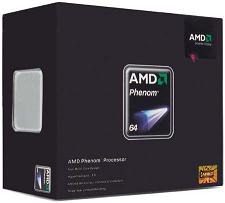
Lets take a look now at the 9600 Black Edition.
| « Back Home | Specifications and Advantages » |