

|
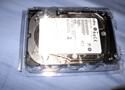


Fujitsu SAS Drives and Highpoint RocketRAID 2640X4 Testing in Linux

Performance
Ext2 Default Options
# hdparm -tT /dev/sdc
	/dev/sdc1:
 	Timing cached reads:   4664 MB in  2.00 seconds = 2334.43 MB/sec
	Timing buffered disk reads:  788 MB in  3.00 seconds = 262.62 MB/sec
We can see from these results, that the cached transfer rate from the disk is around 2.3 Gigabytes per second. This number implies that the data is already present in the cache of the controller, the most optimal case for a transfer. If you compare those speeds with the maximum bus speed that the controller is connected to, you will find them to be similar. This is a good thing; we don't want the controller to act as a bottleneck. The buffered disk read speed of 262 Megabytes per second is well above average. If you refer to my previous article, you can see a marked speed increase.
# iostat -p /dev/sdc -k
	Linux 2.6.18-92.1.6.el5
	Device:            tps    kB_read/s    kB_wrtn/s    kB_read    kB_wrtn
	sdc1            134.72       538.88         0.00    2415548          0
Iostat gives a general idea about the average performance that can be expected when reading from the array. Considering the general case where most of your data is not in the cache, from the previous test, you would expect a read rate of about 260 Megabytes per second. the kB_read/s column shows that the actual read rate was 538.88 Kilobytes per second. This increase shows the efficacy of the cache on the controller.
# ./seeker /dev/sdc
	Seeker v2.0, 2007-01-15, http://www.linuxinsight.com/how_fast_is_your_disk.html
	Benchmarking /dev/sdc1 [279552MB], wait 30 seconds..............................
	Results: 170 seeks/second, 5.87 ms random access time
Seeker is a small utility that gives a general idea of the random access time and the number of seeks per second that a drive is capable of during read operations. When compared to the results of the previous review, there is a slight decrease in the average random access time; this difference could be attributed to the difference in file systems.
# dd if=/dev/urandom of=./tmp/test1 bs=5K count=100
	100+0 records in
	100+0 records out
	512000 bytes (512 kB) copied, 0.0896567 seconds, 5.7 MB/s
# dd if=/dev/zero of=./tmp/test1 bs=10M count=100
	100+0 records in
	100+0 records out
	1048576000 bytes (1.0 GB) copied, 2.21498 seconds, 473 MB/s
The use of DD to test the write performance of a drive, or array of drives is a long honored tradition. We can clearly see that small block sizes tend to take much longer to process. This is due in part to the overhead in sending smaller blocks down the pipe; as well as the inability of the cache to efficiently buffer the input. The larger block size utilizes the cache much more, and reduces the overhead. We can see that the write speed of around 473Megabytes per second is much faster than the speeds acheived in my previous article.

Ext3 Default Options
# hdparm -tT /dev/sdc
	/dev/sdc1:
	Timing cached reads:   4576 MB in  2.00 seconds = 2289.94 MB/sec
	Timing buffered disk reads:  796 MB in  3.01 seconds = 264.88 MB/sec
We can see from these results, that the cached transfer rate from the disk is around 2.2 Gigabytes per second. Once again, the controller is not the bottleneck. The buffered disk read speed of 264 Megabytes per second is well above average again, and is slightly higher than the Ext2 speeds.
# iostat -p /dev/sdc -k
	Linux 2.6.18-92.1.6.el5
	Device:            tps    kB_read/s    kB_wrtn/s    kB_read    kB_wrtn
	sdc1            159.86       723.14         0.00     818157   	     0
On the Ext3 filesystem, we see that the device has a read speed of 723.14 Kilobytes per second. The nature of the Ext3 filesystem structure makes it more sensitive to cache speed increases.
# ./seeker /dev/sdc
	Seeker v2.0, 2007-01-15, http://www.linuxinsight.com/how_fast_is_your_disk.html
	Benchmarking /dev/sdc1 [279552MB], wait 30 seconds..............................
	Results: 170 seeks/second, 5.85 ms random access time
Seeker is a small utility that gives a general idea of the random access time and the number of seeks per second that a drive is capable of during read operations. When compared to the results of the previous filesystem, the numbers are nearly the same. This shows that the filesystem is not a major factor in the random access speeds.
REALTIME PRICING