

Intel's New Family of 800 MHz FSB Processors
Review by Michael
Tran on 6.05.03
Managing Editor: Harry Lam
CPU Provided by Intel
Performance (Continued):
Real World Tests:
Comanche 4 Demo:
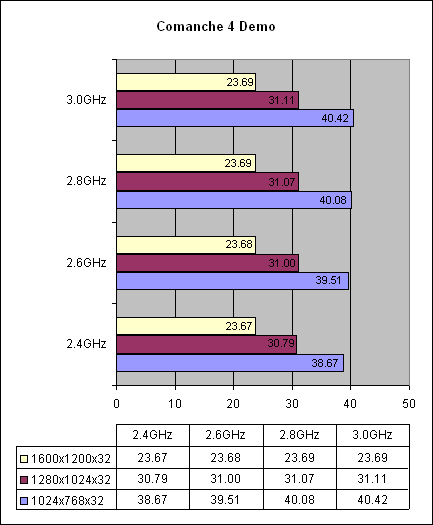
| Processor (1024x768x32) | FPS | Theoretical % | Actual % |
| 2.4GHz 800MHz FSB | 38.67 | 0.0% | - |
| 2.6GHz 800MHz FSB | 39.51 | 8.3% | 2.2% |
| 2.8GHz 800MHz FSB | 40.08 | 16.7% | 3.6% |
| 3.0GHz 800MHz FSB | 40.42 | 25.0% | 4.5% |
When we compare the trends exhibited in Comanche 4 Demo tests with the 3DMark 2003 tests, we can see that Comanche 4 does not stress the video card as much. Despite an overall CPU impact of about 17%-28%, we notice that there is a difference of only 1.75 frames per second (which is relatively insignificant). Since the scores barely increase with increasing CPU speed, the benchmark is video card limited.
| Processor (1280x1024x32) | FPS | Theoretical % | Actual % |
| 2.4GHz 800MHz FSB | 30.79 | 0.0% | - |
| 2.6GHz 800MHz FSB | 31.00 | 8.3% | 0.7% |
| 2.8GHz 800MHz FSB | 31.07 | 16.7% | 0.9% |
| 3.0GHz 800MHz FSB | 31.11 | 25.0% | 1.0% |
When the resolution is increased to 1280x1024x32, the non-existent performance difference at the last resolution is reduced even further. In the last resolution, there was only a 1.75 frames per second difference between 2.4GHz and 3.0GHz, but at this resolution, that difference plunged to only 0.32 frames per second. With this insignificant difference between CPU speeds, we can conclude that this benchmark at this resolution is video card limited.
| Processor (1600x1200x32) | FPS | Theoretical % | Actual % |
| 2.4GHz 800MHz FSB | 23.67 | 0.0% | - |
| 2.6GHz 800MHz FSB | 23.68 | 8.3% | 0.04% |
| 2.8GHz 800MHz FSB | 23.69 | 16.7% | 0.08% |
| 3.0GHz 800MHz FSB | 23.69 | 25.0% | 0.08% |
Since the differences in performance have practically hit a plateau, this test is obviously video card limited.
Jedi Knight II:
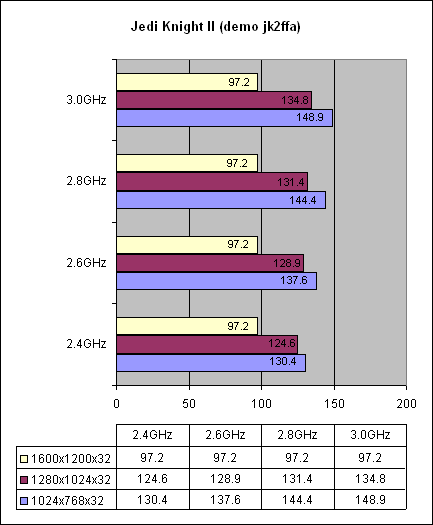
| Processor (1024x768x32) | FPS | Theoretical % | Actual % |
| 2.4GHz 800MHz FSB | 130.4 | 0.0% | - |
| 2.6GHz 800MHz FSB | 137.6 | 8.3% | 5.5% |
| 2.8GHz 800MHz FSB | 144.4 | 16.7% | 10.7% |
| 3.0GHz 800MHz FSB | 148.9 | 25.0% | 14.2% |
Due to the fact that the CPU impact is from 57%-66%, this game is much more CPU dependent than video card dependent. The actual percentage is relatively close to the theoretical percentage, therefore the test is CPU limited with a slope of about 5% per 200MHz increase. At this resolution, the performance is a bit overkill and additional features such as anisotropic filtering or FSAA should be enabled.
| Processor (1280x1024x32) | FPS | Theoretical % | Actual % |
| 2.4GHz 800MHz FSB | 124.6 | 0.0% | - |
| 2.6GHz 800MHz FSB | 128.9 | 8.3% | 3.5% |
| 2.8GHz 800MHz FSB | 131.4 | 16.7% | 5.5% |
| 3.0GHz 800MHz FSB | 134.8 | 25.0% | 8.2% |
Again, the CPU is still the limiting factor but it performance seem to be decreasing with an average slope of 2.7% per 200MHz increase. Since the improvements decreased within this test, the impact of CPU decreased to 32%-42%. At this resolution, the performance is still excessive and additional features such as anisotropic filtering or FSAA should also be enabled.
| Processor (1600x1200x32) | FPS | Theoretical % | Actual % |
| 2.4GHz 800MHz FSB | 97.2 | 0.0% | - |
| 2.6GHz 800MHz FSB | 97.2 | 8.3% | 0.0% |
| 2.8GHz 800MHz FSB | 97.2 | 16.7% | 0.0% |
| 3.0GHz 800MHz FSB | 97.2 | 25.0% | 0.0% |
This test is video card limited at this resolution because the results showed no improvement. Running at 97.2 FPS, this game is very playable but enabling addition options may decrease performance below 60 FPS.
| « Previous Page | Next Page » |