 |
Introduction
As our technology advances, consumers continually demand more from manufactures. Make it faster, make it lighter, make it smaller, and of course do it all at the same time. You would think that we would have hit a limit by now, or at least slowed down, but new cutting edge products keep hitting the market and blowing us away.
One such example of that is the Crucial m4 mSATA SSD we are taking a look at today. Crucial claims this drive packs all of the features, performance, and reliability of the regular 2.5″ m4, but is about 8 times smaller. Read on to find out if it lives up to the claims.
We would like to thank Tiger Direct for providing the hardware needed to test this drive for us. Tiger Direct carries the 128GB version here.
 |
| |
Features
- Award-winning performance. Tiny form factor: Measuring in at about one-third the size of a standard business card (3cm x 5cm), the Crucial m4 mSATA is designed primarily for ultrathin laptop users who want to dramatically increase their system’s performance. Featuring the same advanced controller technology, Micron custom firmware and high-speed synchronous MLC NAND that have made the Crucial m4 SSD a mainstay on the market, the Crucial m4 mSATA SSD is engineered to deliver the same blazing-fast performance as our award-winning 2.5-inch SSD – in a smaller mSATA form factor
- Ultrathin form factor means flexibility: Because of its tiny mSATA form factor, the Crucial m4 mSATA SSD can do things that hard drives and other SSDs often can’t. With the Crucial m4 mSATA SSD, save valuable system space by mounting it directly to the mSATA socket on your motherboard – and free up a hard drive bay in the process. Or just keep your existing hard drive and use the Crucial m4 mSATA SSD as a cache to accelerate the system’s performance. Validated for Intel® Smart Response Technology and NVELO Dataplex™ caching software, it’s designed to work as a cache or as a standalone SSD for ultrathin laptops.
- Consistently fast speeds. No exceptions and no fine print: Unlike other SSDs on the market, Crucial SSDs treat all files the same, regardless of whether they’re compressed or uncompressed. This is important because the files most people use everyday – videos, mp3s, advanced graphics files and zip files – are compressed files and thus unable to be compressed any further. While many SSDs on the market achieve faster speeds by using file compression, many of the most common file types can’t be compressed, resulting in SSDs that often deliver drastically slower speeds than originally advertised. With the advanced technology of a Crucial SSD, however, our advertised speeds are tied to real world use.
- Crucial – quality you can depend on: Crucial is a trusted name when it comes to SSDs, and that’s no coincidence. As a brand of Micron, one of the world’s leading manufacturers of SSDs, Crucial engineers work tirelessly to design, refine, and support a powerful line of SSDs.
Specifications
| Capacity (Unformatted) | 256GB |
| Memory Type | Micron MLC NAND Flash memory |
| Form Factor | mSATA |
| Interface | SATA 6Gb/s (SATA III) |
| Controller | Marvell with Micron Custom Firmware |
| Sequential Read | 500MB/s |
| Sequential Write | 260MB/s |
| 4KB Random Read | 45,000 IOPS |
| 4KB Random Write | 50,000 IOPS |
| MTBF | 1.2 million hours |
| Endurance | 72TB Total Bytes Written (TBW), equal to 40GB per day for 5 years |
| Compliance | RoHS, CE, FCC, UL, BSMI, C-TICK, KCC RRL, W.E.E.E., TUV, VCCI, IC |
Closer Look
 |
 |
 |
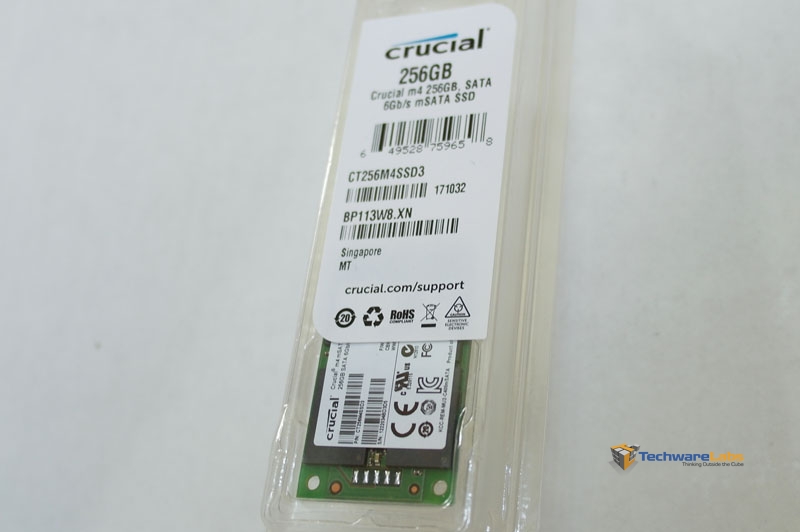
The m4 mSATA drive came to us in very basic packaging with just a little bit of drive information on the front sticker.
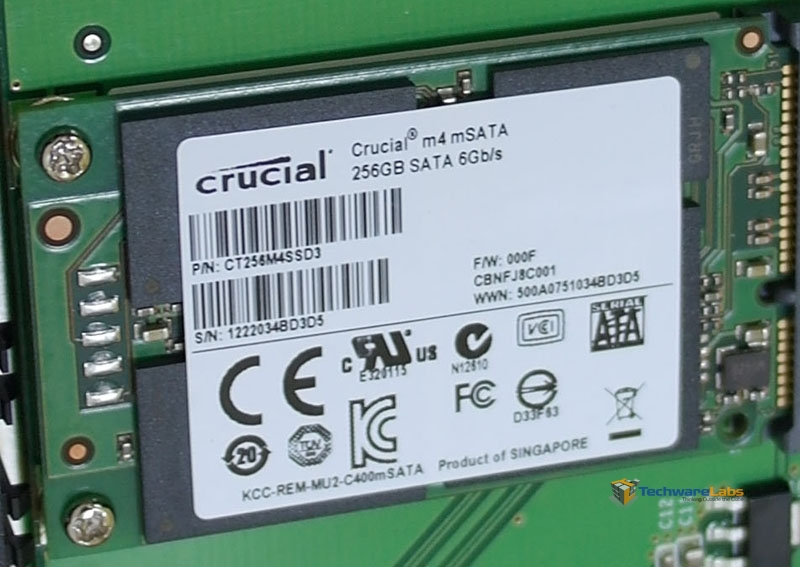
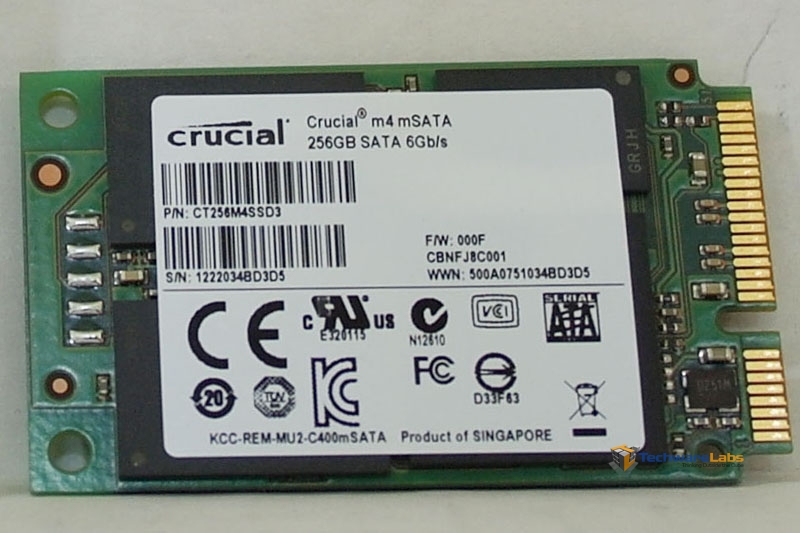
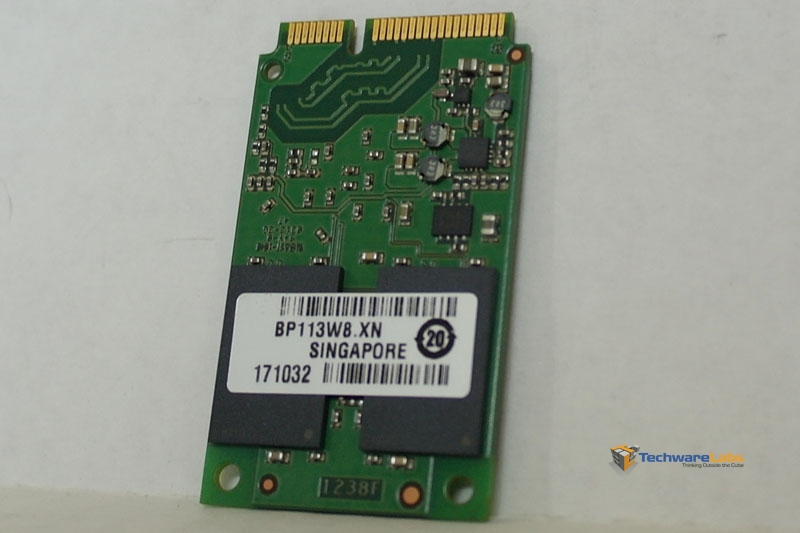
The drive itself is not wrapped in any sort of aluminum case like a regular SSD, rather it is just the bare chips on PCB.
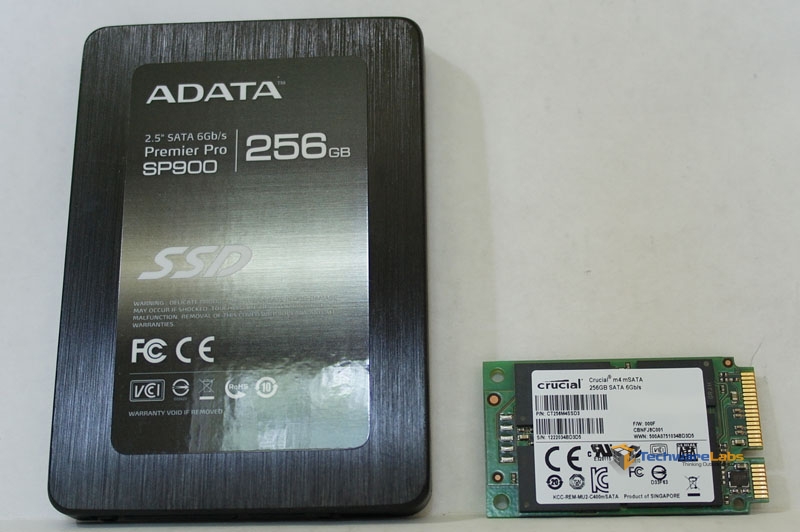 |
To give you an idea of exactly how tiny this drive is, we put it next to a standard 2.5″ SSD. The mSATA drive take up about a quarter as much area and is about half as thick as the regular SSD.
| |
Benchmarks
Benchmarks were run in the Samsung Series 5 Ultrabook using a StarTech mSATA to 2.5″ SATA enclosure.
We are comparing our results with those of the standard 128GB Crucial m4 as well as the ADATA SP900 to give you an idea of how the tiny drive compares to the full-sized ones.
AS SSD
 |
 |
 |
| m4 mSATA | m4 Standard | SP900 |
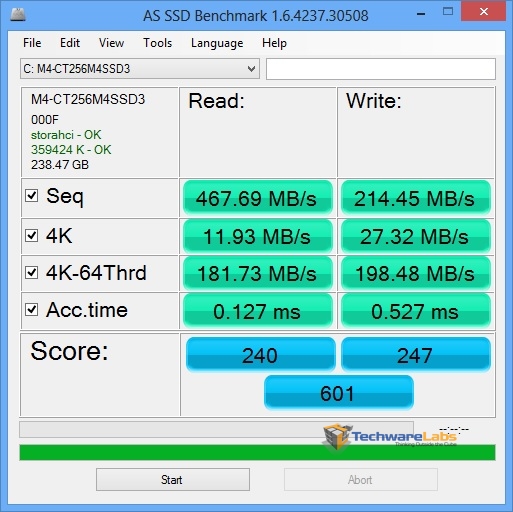
AS SSD tests using incompressible data which provides us with a “worst case scenario”. The mSATA drive gave impressive numbers in sequential read and write, though random read/write speeds were for the most part much lower than its full-size brother.
ATTO
 |
 |
 |
| m4 mSATA | m4 Standard | SP900 |
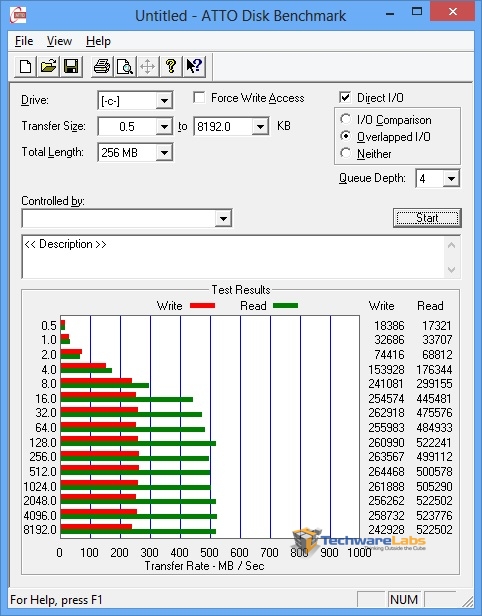
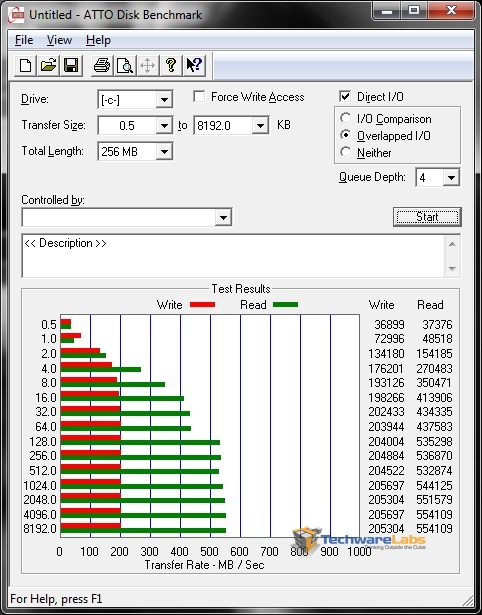
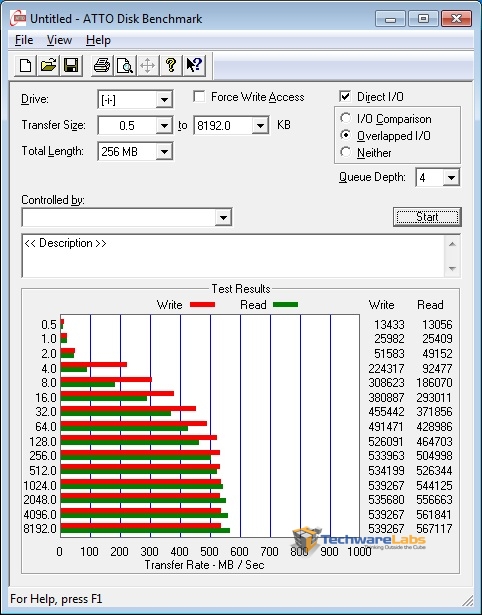
ATTO tests using fully compressible data, which generally gives a “best case scenario”, and is usually what manufactures base their claimed numbers off of. Across the board the reads are slightly lower and the writes are slightly higher than the standard m4.
CrystalDiskMark
 |
 |
 |
| m4 mSATA | m4 Standard | SP900 |
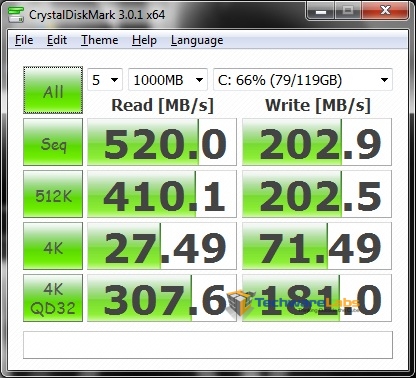
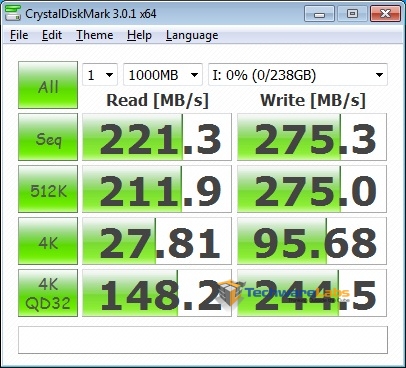
CrystalDiskMark, like AS SSD tests using mainly incompressible data, the m4’s specialty. In this test we again see the mSATA drive perform better with sequential writes and worse with sequential reads, and then struggles with the random reads and writes.
HD Tune
 |
 |
 |
| m4 mSATA | m4 Standard | SP900 |
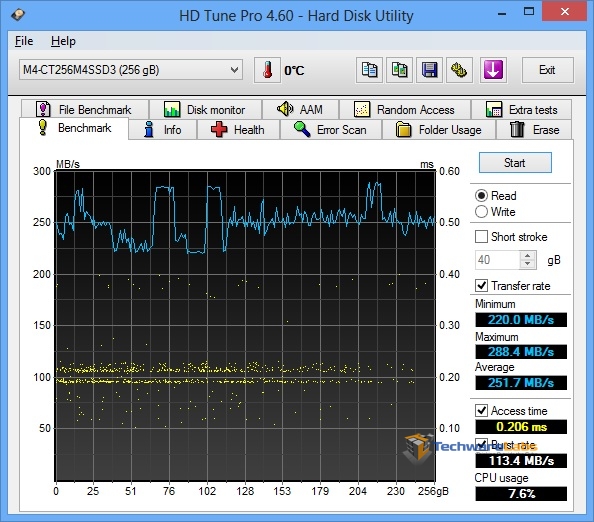
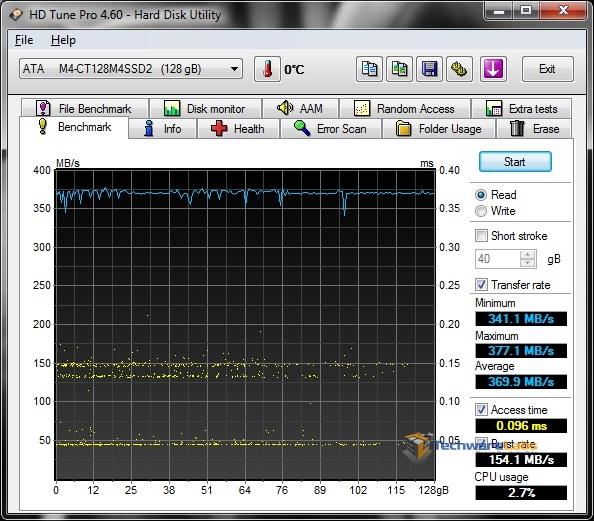
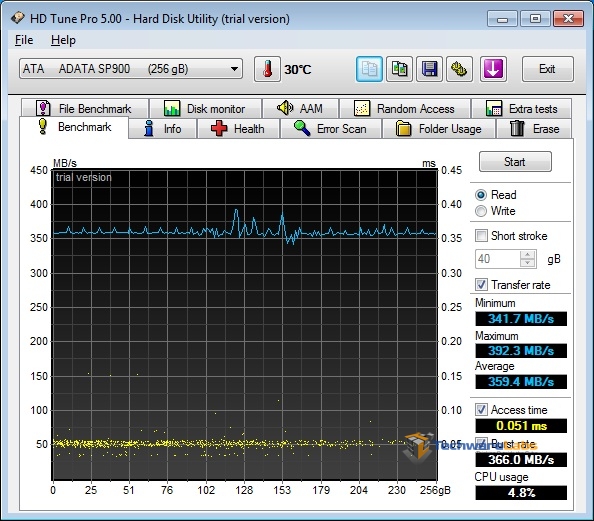
While the other benchmarks give averages of the drives performance in numbers, HD Tune tells you exactly how the drive is behaving through its graph. The mSATA m4’s graph was quite erratic, mainly due to the fact that it was the OS drive at the time. But the standard m4 was also the OS drive when it was tested and its graph is very stable.
The numbers themselves are overall worse, with a lower average and burst rate, and much higher access time.
|
Final Thoughts
Pros:
- Great sequential read/write performance
- Excellent incompressible data performance
- Tiny form factor
- Up to a 256GB capacity
- Price
Cons:
- Lower than Standard M4 SATA random read/write performance
Overall, I found the Crucial m4 mSATA SSD to be very impressive. You get close to the performance of the full-size m4 but in a significantly smaller package. The sequential read/write performance with both compressible and incompressible was great, though the random read/write speeds were quite a bit lower than the standard drive in some cases. But the real pull of this drive is its form factor, which allows you to install it in extremely thin Ultrabooks or to free up a slot in a desktop PC. At basically the same price as the standard 256GB m4 drive (currently about $200), the mSATA drive is also very affordable, allowing you to choose between pure performance at the expense of size, or a tiny form factor at the expense of some performance.
For someone looking for the most power in the smallest package, this is absolutely the drive for them.
Once again we would like to thank Tiger Direct for providing the hardware needed to test this drive for us. See all of Tiger Directs mSATA drives here.
 |

[…] Crucial m4 mSATA 256GB SSD Review @ TechwareLabs […]
[…] Crucial m4 mSATA 256GB SSD Review @ TechwareLabs […]
[…] Crucial m4 mSATA 256GB SSD Review @ TechwareLabs […]
[…] Crucial m4 mSATA 256GB SSD Review @ TechwareLabs […]
[…] SSD Reviews Thread Crucial m4 mSATA 256GB SSD Review http://www.techwarelabs.com/crucial-…gb-ssd-review/ Corsair Neutron 240GB and Neutron GTX 240GB SSD Review […]
[…] Crucial m4 mSATA 256GB SSD Review Crucial m4 256GB mSATA SSD Review | TechwareLabs Corsair Neutron 240GB and Neutron GTX 240GB SSD Review Review: Corsair's Neutron and Neutron GTX […]
[…] m4 mSATA 256GB SSD Review Crucial m4 256GB mSATA SSD Review | TechwareLabs Corsair Neutron 240GB and Neutron GTX 240GB SSD Review Review: Corsair's Neutron and Neutron GTX […]
[…] KitTechReviewSource spends some time with the Canon Selphy CP900TechwareLabs weighs in on the Crucial m4 mSATA 256GB SSDMissingRemote checks out the Pulse-Eight Internal HDMI CEC AdapterRage3D explores the Lian Li PCQ12 […]