WinRAR
Perhaps one of the most common tasks in a computer user’s day is moving files around. Archive formats like RAR and 7zip offer a convenient way to package up files and send them over the internet, but getting the files back out again means unpacking the archive, a task where the CPU is quite important:
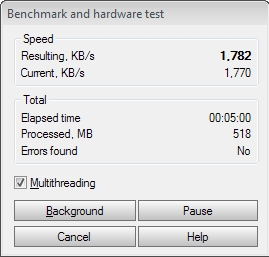
According to WinRAR’s inbuilt testing, the X4 640 managed to crunch through nearly 1.8MB/sec, quite a respectable rate for RAR’s high-compression format.
Cinebench 11.5
Maxon’s Cinebench software is based off their Cinema4D 3D rendering suite, which is often employed to produce high-quality computer-generated graphics for movies and TV. Cinema4D, and by extension Cinebench, can scale to utilize up to 64 CPU cores. This offers a clear look at the benefits of parallel processing, and how a good multi-core CPU can speed your workflow. Their scoring is as arbitrary as any, but simply watching the test render will give you a clear idea of the speed you can expect from the full product.
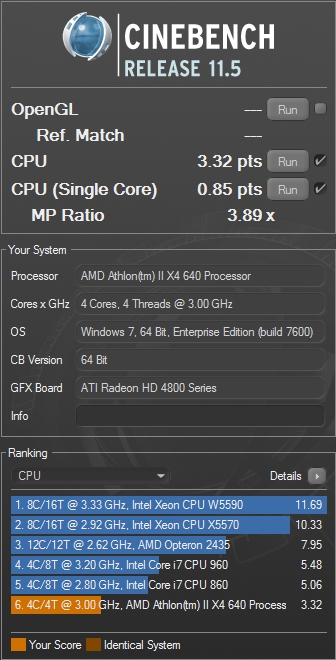
Here the multicore test showed a 3.89x speed multiplier over the single-thread render, which is very close to the theoretical ideal. Perfect 1:1 speedup is not possible on multicore systems, due to inter-core communication overhead, but the results show that the X4 640 isn’t wasting a lot of time talking to itself while under load.
Crysis Warhead

It’s difficult to find a game that truly stresses the CPU these days, as more and more of the work is being moved to the GPU. Still, CryTek’s engine finds plenty of work for the CPU to do while the GPU staggers under its monstrous load. For this test, we ran a number of timedemos in two of the game’s most demanding levels, ambush and avalanche, in both DirectX 9 and DirectX 10 modes. To try to eliminate statistical outliers, we ran each timedemo three times at the indicated settings. With the resolution set at 1680x1050noAA and all presets set at Gamer (medium-high), framerates averaged thus:
| Level | Frames per second |
| Ambush (DX9) | Min: 18.50 Max: 33.63 Avg: 26.14 |
| Ambush (DX10) | Min: 1.14 Max: 30.09 Avg: 23.05 |
| Avalanche (DX9) | Min: 15.89 Max: 38.46 Avg: 29.08 |
| Avalanche (DX10) | Min: 18.48 Max: 35.45 Avg: 26.77 |
As expected for a mid-level 4800 series Radeon card, the framerates are playable, if slightly choppy. The unusually low minimum fromerate on Ambush (DX10) was caused by a persistent hitch in loading at the beginning of the level. Once it got going, the framerate stayed steady in the low 20s, which is on the low side of playable for most singleplayer FPS games. Shrapnel-heavy grenade blasts and other physics interactions, which the CryEngine handles on the CPU, went off without any noticeable slowdowns. Again, please note that the raw horsepower of the graphics card is at least as important as the CPU for high-resolution gaming.

Anyone have the foggiest idea what this says?