Tech Geekery, and Fiddly Little Concerns:
- O-rings and threads came bone dry. I may be wrong and there was a very fine lube, but it seems to be shedding aluminum powder after a few on-off cycles and turns rather roughly.
- Threads were an unusual combination of conventional, saw-tooth shape (sloped edges) and the unusual square threads (flat tops) found on the Surefire Aviator. Machining on them was a bit course, but they ensured there was no threat of cross-threading.
- Clip held tight, but was a little hard to put on a pocket. Thicker pockets might play badly with this clip.
- The tailcap guards are drilled for a lanyard, but the holes are just a bit over 1mm – a bit thin for paracord.
- The window is reportedly high-quality uncoated polycarbonate.
- The reflector has an unusual, light texture which is not so smoothly textured as most, and consists of flat plateaus on the ‘flat’ surface of the parabola.
- There was an intermittent problem with the circuit, which lead to flickering and a diagnosis of a dead battery – but only once. Manipulating the tailcap fixed it, but it came back. The second time, it was much more flickery and less not-turning-on.
- Threads became much smoother with a generous dab of Magic Lube, a silicone/teflon grease used to seal O-rings on swimming pools (what I keep on hand). This also may have fixed the flickering issue.
- Mechanical reverse-polarity protection; the positive contact in the head is reversed inside a shallow divot just big enough for the + terminal on a AA battery.
I got to playing with the multimeter a bit, and took some voltage and current measurements in place of the tail cap. The battery measured 1.256 volts, and I’ll assume it’s constant when the light is switched on. Set to high, it pulled 0.45 amps; on low, it drew 0.14 amps. Multiply these, and the result is 0.56 watts on high, and 0.17. At 65/20 lumens, this gives 115 and 113 lumens per watt, respectively. I know for a fact that the highest bin being sold is the M bin, producing 90 to 100 lumens per watt, so there seems to be something slightly fishy going on here. First I must check my assumptions: I am assuming that the rated brightness is correct, I am assuming my meter is accurate, and I am assuming the battery is not dropping voltage under load. The most unlikely of these is that the battery is not dropping – though if they were, the regulator circuit would pull more current to compensate, dropping the calculated lumens/watt. This means that this is not the effect seen here. More data can be gathered by using an Energizer lithium AA, another battery that yields a very constant voltage under load. The example I had was partially depleted, clocking in at 1.562 volts; on high, the circuit drew .53 amps, and .19 amps on low (translating into .83 and .30 watts, respectively). Why is this important? At higher voltage, the circuit drew higher current. This gives us 78 and 67 lumens per watt for the entire flashlight’s emitter and electronics at rated brightness. These numbers are quite realistic, suggesting I made a mistake assuming the light operates at full brightness on rechargeable batteries. While the documentation included states that the Lightning Strike is compatible with “quality AA size Alkaline or Ni-MH batteries and with min capacity 1600mAh”, the use of conventional rechargeable is also not recommended. (The use of rechargeable alkaline cells, a type of battery no longer widely sold, is according to the manual capable of damaging the light over time, probably by over-driving and frying the LED.) Take home message of this paragraph? Lithium AAs are the best battery for this light, followed by good nickel metal hydride rechargeable (I use and recommend Sanyo Eneloops) followed finally by normal AA alkaline cells (which the manufacturer recommends replacing every two months regardless of the lack of any actual use).
|
 |
|
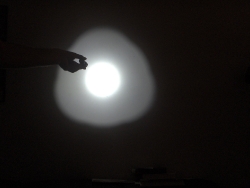
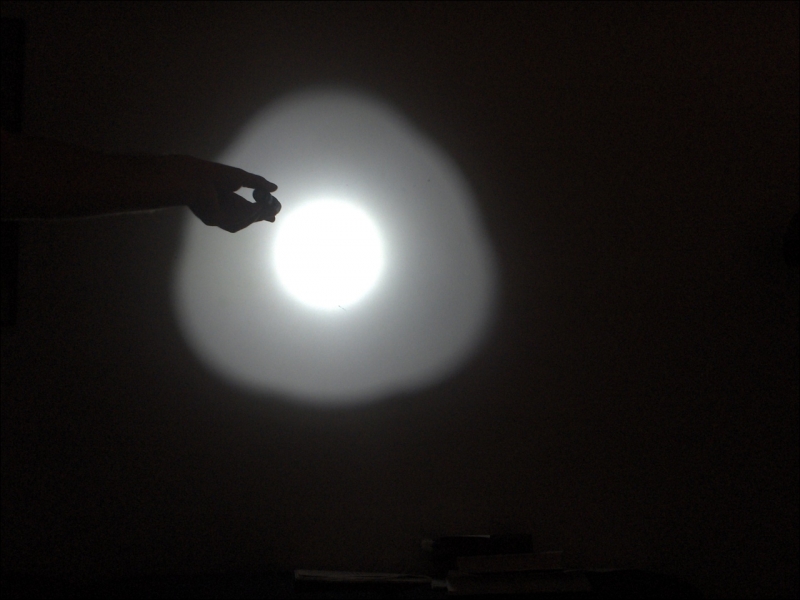
Lightning Strike beam profile at 1/2 meter |
Related


[…] Brite-Strike Lightning Strike Tactical Flashlight Review @ Techwarelabs […]
[…] Brite-Strike Lightning Strike Tactical Flashlight Review @ Techwarelabs […]