HD Tune 3.00
|
HD Tune 3.00 Read Test
|
|
 |
 |
|
Barracuda 7200.11 @ 300 GB |
Velociraptor |
|
HD Tune 3.00 Write Test
|
 |
|
Barracuda 7200.11 @ 300 GB |
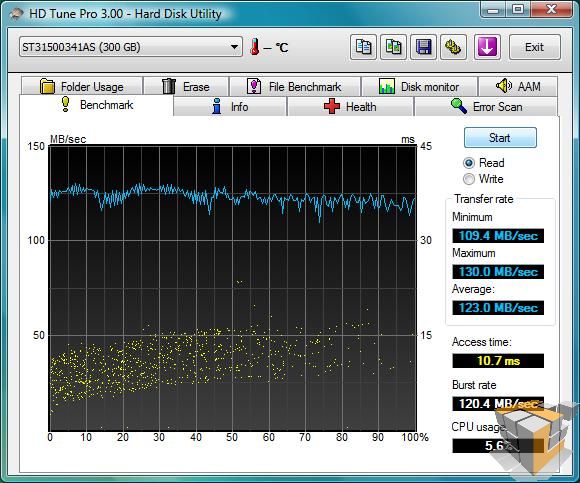
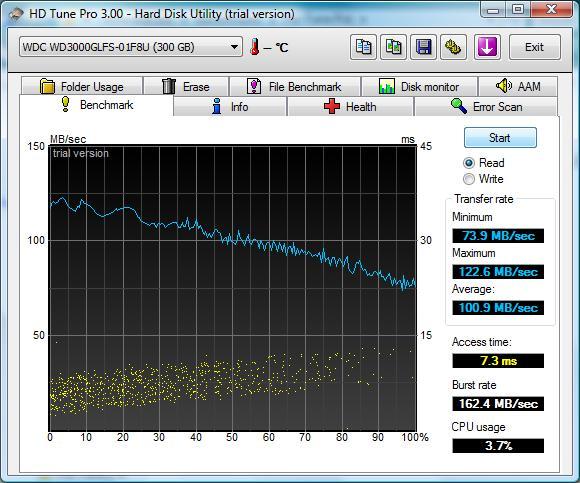
This benchmark performs sequential read and write tests across the whole drive and displays the average, min and max. Because all drives are structured like disks, the data located towards the end of the drive (towards the edges), is more separated than the data located near the center, hence it takes less time to locate, read and write information to and from the drive. Since the drive is 1500 GB in size, 300 GB ends up being 20%. By setting the size to 20 % of the max, the drive uses the inside 20% of the disc thus bringing superior performance.
|
HD Tune 3.00 File Access Test
|
|
 |
 |
Barracuda 7200.11 @ 300 GB |
Velociraptor |
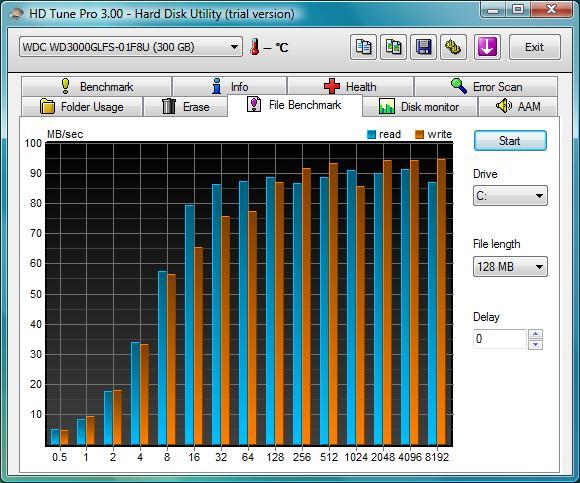
The file access test reads the speeds at which files with different block sizes can be accessed. Here you can see that the Barracuda has faster access times for all block sizes above approximately 16KB.
|
HD Tune 3.00 File Access Time
|
|
 |
 |
|
Barracuda 7200.11 @ 300 GB |
Velociraptor |
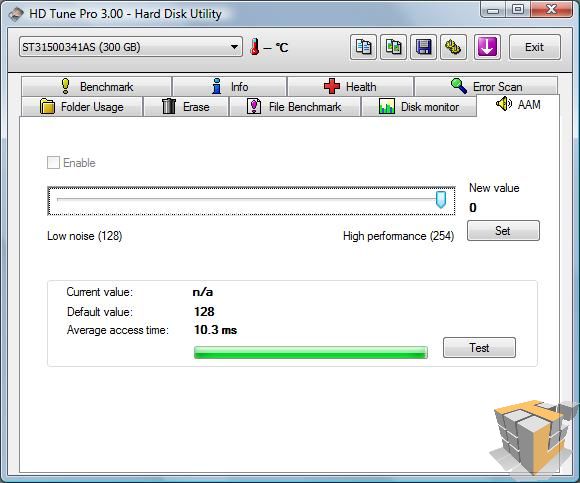
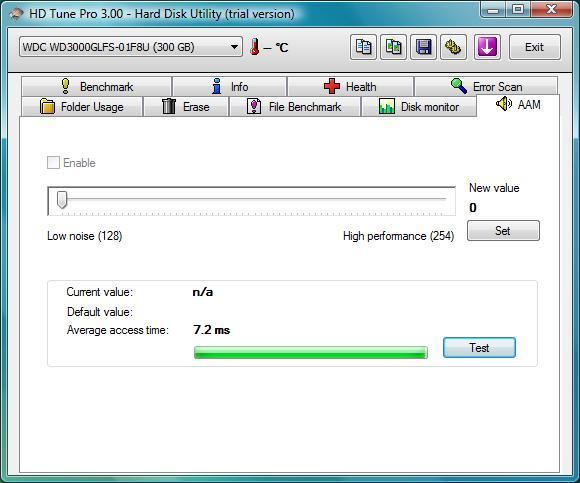
The Velociraptor beats the Barracuda by approximately 3.1 ms in access times. The 7.2 ms compared to the 10.3 ms in favor of the Velociraptor comes from the 10,000 RPM speed, however, the Barracuda performs admirably with small loss which would unnoticeable during sequential reads and writes.
DataMarck
|
DataMarck
|
|
 |
 |
|
Barracuda 7200.11 @ 300 GB Read |
Velociraptor |
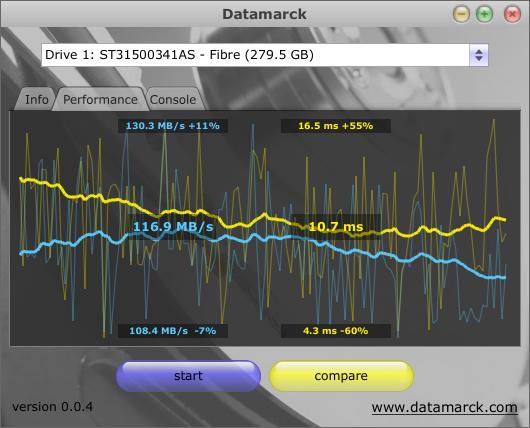
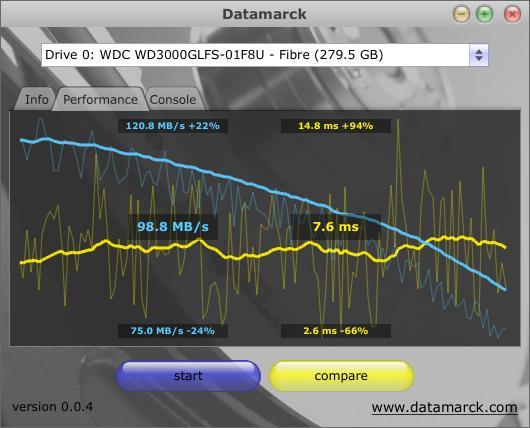
DataMarck benchmark is very similar to HD Tune 3.00. Again we can see the 3.1 ms difference in access times between 7.6 for the Velociraptor versus the 10.7 for the Barracuda. The Barracuda, however, still manages to pull ahead of the Velociraptor by approximately 16 MB in read speeds across the whole drive.


Perhaps someone, preferably an everyday computer user, with this type of hard drive could try the hack and let us know how it performs. If I had one I would give a whirl. In my opinion it would be worth it up to the point of being full, then you could always move on to the 819 GB setup.
Thanks for the review Artiom.
Chris: “while partitioning the drive does allow similar effect, it is not the same”
Yeah, it’s not the same… it’s something that actually has some sense in it, unlike capacity clipping HDD on firmware level.
___
Chris: “If you do have it partitioned, anything accessed on the 1 partition would be the fastest, however if you try and access anything on the other partition at the same time, the performance would drop significantly”
Yeah… which is why you would install OS and all applications on same partition, and leave the second partition for stuff like movies, mp3s, OS back-up images… stuff that you don’t need to load while booting OS or load heavy applications.
___
Chris: “Saying that you won’t access the second partition whenever you want to use the first isn’t really practical either”
Eh… on the contrary, if you for example store HDTV movies, and other rarely used, very big files to the remaining 1.2 terabytes of space, you really don’t need to read those files while booting OS, loading WoW or basically doing anything else than watching them (and watching them is done by loading a small non-bloated application like Media Player Classic).
Really, I see absolutely no damage in using the leftover space for stuff that is rarely accessed.
This “hack” is the most bafflingly idiotic hack I’ve ever read. It’s a very bad variant of a VERY old partitioning hack.
___
Artiom: “This means that there is no guarantee that all of the LBAs are going to be on the inside of the drive which is what gives it the boost it needs.”
Except the inner tracks are the slowest. rpm is same on inner and outer diameter, but on outer diameter, the circumference is bigger, thus more bits travel below the R/W head in a time interval.
can this hack be done on other drivers from seatgate maybe like the 1T version….?
Yes performance, yes cheap price. What about reliability? This is often overlooked. I’ve had nothing but trouble with seagate drives. I would rather spend a bit more for quality/reliability.
Why downsized the 1.5tb offering ?
Just buy the 320gb version ?
http://www.seagate.com/ww/v/index.jsp?locale=en-US&name=st3320613as-barracuda-7200-11-sata-320g-hd&vgnextoid=e7c048e03b758110VgnVCM100000f5ee0a0aRCRD&vgnextchannel=47f281f8c0f43110VgnVCM100000f5ee0a0aRCRD&reqPage=Model
Actually my experience is exactly the opposite. Seagate drives have time and again proven themselves much more reliable than most of the competition. I recommend either Western Digital or Seagate to everyone.
I, on the other hand, recommend everyone stay way from WD and Seagate and heavily favor Hitachi and Samsung.
(OK, WD has gotten its act together, but I still won’t ever forgive them for the _8_ (yeah, 8) RMAs he had to go through…started with a 20gb and ended up with a 120gb, all failing in a 6 month period. Oh, and the 50% WD RMA rate at our shop… ugh)
getting more for less is what it’s all about. That’s why we overclock.
So, for the price of 1 Velo, i could buy two of these and RAID 0 them. I’m assuming a RAID 0 of these would destroy a single Velo, for the same price as that single Velo?
This is a rather misleading article. There is no way that you can simply ignore the superior seek time of the Velociraptor and just dismiss it as a minor difference. It’s the seek time of the velociraptor which makes it so desirable, not the sustained transfer rate. The seek time is what reduces stuttering in games for example, sustained transfer rate just makes things like defragmenting the drive faster.
The problem with just partitioning the drive is that windows does it dynamically. This means that there is no guarantee that all of the LBAs are going to be on the inside of the drive which is what gives it the boost it needs.
I have learned that The outside of the drive is the fastest.
There is no benefit in making the rest of the disk invisible. Partitioning the drive does exactly the same thing. This tecnique is old, and I’ve seen reviews on several other sites (tom’s hardware being the first that comes to mind).
Think about it, while partitioning the drive does allow similar effect, it is not the same. If you do have it partitioned, anything accessed on the 1 partition would be the fastest, however if you try and access anything on the other partition at the same time, the performance would drop significantly as the drive’s head has to move to the other sectors on the second partition and then back to the first. So in fact partitioning it in two would not have the same effect as this method if you plan on actually using the remaining space. Saying that you won’t access the second partition whenever you want to use the first isn’t really practical either.
Instead of changing the LBA value, all you have to do is partition the drive to use the first 300gb or whatever you want for your system drive. There is NO benefit in making the rest of the drive invisible. You could still be using the remaining 1.1~1.2 tb for data.
Well Captain Obvious, you should know that there IS a difference. and as Captain Obvious, you should have found this:
http://enterprise.media.seagate.com/2009/07/inside-it-storage/the-fastest-gaming-drive-alive-barracuda-7200/
Apparently, even Seagate agrees 🙁
where IS the difference?
I wonder if this trick would work on a Seagate’s FreeAgent 1.5 TB External hard drive?
Even if you could do it (I don’t believe you can) you would still be horribly bottlenecked by the USB 2.0 connection. It doesn’t look like the FreeAgent line have an eSata connection, which is what would be required to see any benefit from this hack.
It’s not a USB drive. You’re looking at an ad listing a usb drive for sale.
LOL what`s the point making this on externall hdd? when USB can`t handle even close performance to S-ata. Or Do you have Firewire B rack?